Macroscope Nexus: the Observatory →
PublicThe public Macroscope. Enter any coordinate on Earth and discover its ecological identity, read from terrain, climate, ecoregion and the living world.
macroscope.nexus · yea.earth, Your Ecological Address
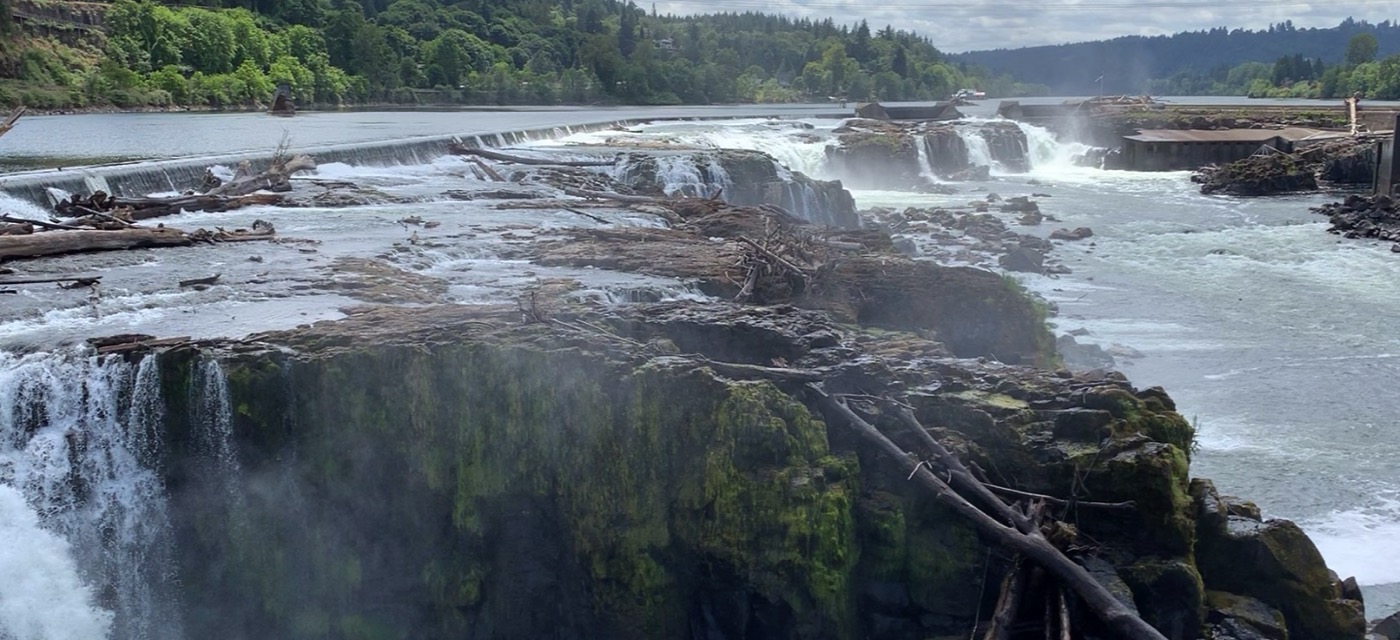
The Canoe Place · above Willamette Falls
An independent laboratory for the design, engineering and development of the Macroscope: an open ecological observatory in which a place reads its own ground.
The question we work on: can a field station read everything its instruments, community records and satellites say, in its own vocabulary, with provenance intact?
Canemah, right now · the live pulse from the bluff above the falls
The public Macroscope. Enter any coordinate on Earth and discover its ecological identity, read from terrain, climate, ecoregion and the living world.
macroscope.nexus · yea.earth, Your Ecological Address
The fourth generation, built in the open and changing daily: about 1,170 curated places, from biological field stations and UC Natural Reserves to public lands, the laboratory at Canemah and the Owl Farm testbed, each read across four faces.
Structured human-AI scientific investigations, and the essays in which the ideas behind the Macroscope are worked out in public, one morning at a time.
The Macroscope, measured 25 September 2026
A microscope makes the very small visible and a telescope the very far. A macroscope is for what is too large, too slow and too interconnected to see at once: a watershed, a season, an ecosystem, a life of paying attention to one piece of ground.
The world arrives as coordinates. A place is a coordinate someone has decided matters and has curated. A survey is a bounded act of looking; the pulse is what keeps arriving between surveys. Places run from deeply known, walked and ground-truthed, to lightly sketched from public data, and the two are always told apart.
Stand at any coordinate and it turns four faces toward you at once:
Since 2025 the Macroscope has been designed and built by a field ecologist and Claude, Anthropic's AI model, in near-daily sessions. The human keeps the judgment, the machine does the engineering, and every design ruling is written down.
Claude writes and reviews the database, the data collectors and the reader, and tests each change against a local copy before anything reaches the production substrate.
The STRATA context engine calls Claude to say what the instruments and reference layers show, and only what is measured: narration is arithmetic over state, never speculation.
More than a hundred design rulings, the seven-phase investigations and the essays behind them are published as they happen at Science with Claude.
The boundary is deliberate. Claude does not identify species or classify pixels; specialised models do: Pl@ntNet now and BioCLIP 2 next for species and, in the proposed work, OlmoEarth for the satellite record. Claude designs, runs and interprets them, and the naturalist makes the call.
The next loop to close runs from the panorama to the satellite: a place that can map and monitor its own plant communities and seasons, in its own vocabulary, with provenance intact.
Inquiries about the program and the platform are welcome. Of peers we ask what the instrument asks of us: argue with it. Get in touch →
The laboratory's numbered series of technical notes, specifications and white papers.
This note records the conceptual architecture for a wearable sensor-fusion rig intended to support ecoSPLAT surveys at Canemah Nature Laboratory...
July 23, 2026The original Climate Analyst Data Logger Designer (CNL-TN-2026-052 v0.1) specified a Climate-Analyst-internal wizard that provisioned virtual weather...
April 16, 2026This specification establishes a portable visual language for Macroscope Next Generation (MNG) interfaces, derived from analysis of production CSS on...
April 15, 2026The Macroscope Collaboratory Librarian was instantiated in early April 2026 as a catalog system for Dr. Hamilton's personal library, initially...
April 13, 2026The Macroscope Collaboratory Librarian is the fourth panel of the I3 shell (Instruments, Investigations, Intelligence, Librarian) and serves as the...
April 11, 2026The first-light OCR evaluation on April 10, 2026 (see REPORT.md in `tests/ocr_bench/`) compared two text extraction pipelines against four PDFs:...
April 10, 2026An API key for the Semantic Scholar Academic Graph was obtained on April 11, 2026, providing authenticated access to Allen AI’s corpus of...
April 10, 2026Versions 0.1 and 0.2 of this technical note documented the first-light test of the Investigation Wizard as a PHP in-request application driving the...
April 9, 2026STRATA 2.0's Observatory and Intelligence dashboards currently generate all sensor summaries, narrative text, and ecological context on demand --...
April 8, 2026STRATA's intelligence tier currently operates without place. The temporal state endpoint assembles sensor readings from 26 platforms across four...
April 8, 2026Photographic studies from a digital naturalist's eye
Text adventure with living data
Collaborative puzzle poetry
Cognitive poetry from the dream buffer
Curated wisdom across domains
Visual navigation through ideas
My Virtual Field Station